Showing posts with label Miscellaneous. Show all posts

Sunday, December 16, 2018

Chess960

Chess960 is a super fun chess variant where the starting position of the pieces on the back rank is randomized (though still symmetrical). It gets its name from the fact that there are 960 distinct starting positions that can arise from the randomization of the back rank. Chess960 is also known as Fischer Random Chess, since Bobby Fischer is the one who invented this variant. The main purpose is to steer away from the modern game, which is based a lot on memorization of opening theory, and to give way to strategic creativity.


Rules for Starting Positions

According to our good friend Wikipedia, there are two restrictions for the starting position, both of which seem rather obvious: the bishops must be on opposite-color squares, and the king must be placed between the rooks.


Castling

I find castling a bit tricky in Chess960. The confusing thing about castling in Chess960 is that even though the king and rooks are typically not in their standard position, the rules for castling remain pretty much the same as in standard chess, which can lead to weird stuff--sometimes you can even castle and have only one of the two pieces change positions, or have the king and rook move many squares at once!

The key thing to remember when castling in Chess960 is that the resulting king and rook position is exactly the same as in standard chess. This means that castling a-side (as it's called in Chess960) leads to the king sitting on c1 (or c8) and the a-side rook sitting on d1 (or d8), while castling h-side leads to the king sitting on g1 (or g8) and the h-side rook sitting on f1 (or f8). As in standard chess, you cannot castle if a square in the king's path is attacked or occupied by a piece, or if the destination square for the king or rook is occupied by a piece. Note that just like in standard chess, a-side castling is notated O-O-O, and h-side castling is notated O-O.

I suppose the mechanics for castling online depends on the specific website, but on lichess, you can castle in Chess960 by dragging the king to the rook with which it wants to trade sides. Here's an example game in which I tried to castle but it all went wrong: rather than dragging the king to the rook, I dragged the king to its intended destination square, which was interpreted as a normal king move. On move 5, I tried castling a-side, but I played 5. Kc1?:


Stockfish evaluates the position has having gone from about +0.5 (a half-pawn advantage for White) to about -1.7 (nearly a two-pawn disadvantage for White!) after 5. Kc1. In fact, following this mishap, the rook on a1 didn't get to enter the game until move 32:


Popularity

On December 16, Chess960 was the most popular of non-standard chess variants on lichess, even ahead of UltraBullet, which is standard chess with an extremely fast time control. This table shows the number of people who played each variant this week:

Popularity RankVariantNo. of Players This Week
1Blitz214213
2Rapid115104
3Bullet102849
4Classical58231
5Chess9604955
6UltraBullet4858
7Crazyhouse4255
8Antichess3731
9Atomic2512
10Horde1429
11Three-Check1383
12King of The Hill856
13Racing Kings809

It's clear that non-standard chess variants are much less popular than standard chess variants (which vary only in their time controls), but Chess960 fares well relative to other non-standard variants.


Seeing Chess960 in Action

If you want to see Chess960 in action, you can take a look at the top-rated Chess960 game on lichess being played right now on LichessTV.

You can also take a look at my most recent stream on Twitch, in which I played the daily Chess960 tournament (5-minute games)... I played a total of 9 games and finished 9th (win rate = 56%, performance = 1880):


Thursday, November 2, 2017

My queen is invisible #2

After a long period of queens behaving normally, I have now encountered two more opponents who gave up their queen to recapture a piece that's defended, for no apparent reason. If you recall, I had encountered two opponents in two days who had done exactly the same thing: use their queen to capture a piece as if the piece was hanging, but which was actually defended by my queen. I had therefore concluded that my queen is invisible, as anyone would.

In the first game below (played yesterday), the same scenario occurred: My opponent captured a piece with their queen, which was protected by my own queen. But in the second game (played today), there was a new twist: My opponent used their queen to capture a piece that was defended by my rook and not my queen! So there is nothing left for me to do but to revise my theory. I now think not that my queen is invisible, but perhaps that my opponents think their queen is invisible? Or maybe invincible? But I will need more games to figure this out.

In the meantime, I've added the category Eerie for this post and the earlier post, for the inexplicable phenomena that we encounter in chess.

In the first game (a 1-minute game on lichess.org), we reached this position after 15. ... h5:


For better or worse, here I decided to play 16. Qb1 to prevent Black from playing the advance d3 (I'm now X-raying that square). My opponent continued his play on the kingside with 16. ... h4, and I responded with 17. g4, preferring to keep things closed where my king is. And then my opponent decided to push his central pawn anyway and played 17. ... d3?:


And after 18. cxd3, my opponent simply played 18. ... Qxd3?? 19. Qxd3.

In the second game (also a 1-minute game on lichess.org), my opponent just made a mistake with 10. ... Bd6?:


This allows me to win a piece with the simple tactic 11. e5 Bxe5 12. Nxe5 Nxe5 13. Bxe5:


And here, my opponent clicked on his invisible queen (or so we think) and played 13. ... Qxe5?? 14. Rxe5.

Both games are available here: 


Tuesday, October 31, 2017

Twice the same position at move 14, and an improvement that failed

Merry Halloween!, or whatever. It's fitting that today's the Halloween because this is a scary post--soon I'll add a category "Eerie" for posts like this one and the one about the invisible queen.

Yesterday I played two bullet games against the same guy within a few minutes, and astonishingly or not, we reached exactly the same position in both games at move 14. The move order was slightly different (starting at move 8; I tried to improve my move order the second time around). My opponent chose a different continuation at move 15 because he lost a piece in our first game, and it should have been a better continuation had he found the best move, but to no avail, he ended up losing an exchange in the worst way possible in the second game.

Here's a side-by-side comparison of the games:

Game #1:
1. e4 c6 2. Bc4 d5 3. exd5 cxd5 4. Bb3 Nf6 5. d4 Bg4 6. f3 Bf5 7. Ne2 Nc6 8. O-O e6 9. c3 Bd6 10. Ng3 Bg6 11. Bd2 Qc7 12. Be1 O-O 13. Nd2 Bf4 14. Bf2 Na5

Game #2:
1. e4 c6 2. Bc4 d5 3. exd5 cxd5 4. Bb3 Nf6 5. d4 Bg4 6. f3 Bh5 7. Ne2 e6 8. O-O Bd6 9. Bd2 O-O 10. Be1 Qc7 11. Ng3 Bg6 12. Bf2 Nc6 13. Nd2 Bf4 14. c3 Na5


Game #1: 15. Bc2
Game #2: 15. Re1


Game #1: 15. … Nc4 16. Bxg6? Nxd2!
Game #2: 15. … b5 16. Bc2 Nc4 17. Bxg6? Bxd2!


Game #1: 17. Bxf7+ Qxf7 18. Re1
Game #2: 18. Re2 hxg6


Game #1: Here I played 18. ... Nc4 and I'm up a piece.

Game #2: 
Here my opponent needed to play 19. Rxd2 Nxd2 20. Qxd2, 
still conceding the exchange (why not play 18. Bxh7+ otherwise?). 
Instead, he tried to deflect my knight from the defense of the bishop.

19. b3? Bxc3 20. bxc4 Bxa1 21. Qxa1 dxc4

And here I'm up an exchange with a protected passed pawn.


Here are the two games in full (1-minute games on lichess.org):

Game #1:


Game #2:

Thursday, October 5, 2017

Chess Joke

Nothing beats a good joke about chess patterns:


Wednesday, September 20, 2017

Cheating in Online Chess

I was wondering: How prevalent is cheating in online chess? More specifically, it would be great to get an estimate of the percentage of games that involve cheating in the form of engine use.

I couldn't get an exact answer to this question, but I think the answer is that it's prevalent enough to be bothered by it. Chess.com even has a private forum dedicated to the discussion of online cheating in chess (you need to submit a request to be admitted into the forum, and there are some restrictions--like having been a member on the site for at least one month--but overall it's easy to gain access). Chess.com also employs two full-time employees whose only task is to research and prevent cheating on that site. Similarly, both lichess and the Internet Chess Club have systems in place to detect cheating (sometimes doing automatic checks while the game is being played).

Five Percent?

The question about cheating prevalence has been asked several times over the years on multiple forums (like here). One user estimated the prevalence at 5%; another user said that a chess.com employee told them that 70% of games involve cheating (that's just hearsay, and 70% does sound pretty implausible). Yet another user said that the prevalence is "considerably higher" than 5% if your rating is high enough (1800+). One lichess user who is a National Master mentions on reddit that looking through his history of games in the classical category (8+ minutes), “about 80% of my losses were to people that subsequently had their accounts closed for cheating”

The 5% figure is one that seems to come back in forum posts. This figure was also mentioned by one of the lichess developers on reddit, 2 years ago:
About 1.2k accounts are make on lichess each day, and each day some 50 or more get marked (this number is set to increase as our detection system has just become fully operational). So if we assume that all cheaters use new accounts, about 4-5% of new accounts are cheaters. This figure has remained about the same since I started on the site and there were half as many new accounts made each day.
It's far less likely for a cheater to be using an older account, so that figure drops dramatically once they've played a hundred or more games.

Miscellaneous Stuff about Cheating in Chess

  • At least one person has proposed a hypothesis test to detect cheating in online chess, and one International Master (also an Associate Professor in the Department of Computer Science and Engineering at the University at Buffalo) used statistics on the case of Borislav Ivanov, accused of cheating at the 2012 Zadar Open.
  • Wikipedia has an entry for cheating in chess. Among other events recorded there, one grandmaster was stripped of his GM title for cheating, though he was allowed to keep his IM title.
  • Chessbase.com has a 5-part series on the history of cheating in chess.
  • GM Vladislav Tkachiev shows on YouTube just how easy to cheat with an accomplice using an earpiece in a video called How I Became a Cheater.
  • There used to be a user on lichess, who was later banned, with the nickname IMaDirtyCheater, who made it very clear that he was cheating; his profile read:
I cheat, it should be obvious!
Really obvious...
  • Some users have written programs to cheat directly from the same window the game is being played on; one such example is shown in a YouTube video on a lichess bullet game (I don't provide the link to the video because the description contains a link to the program, which is freely available on github). The resulting board looks like this, with the move recommended by the engine being indicated through a dark square (starting destination) and red square (ending destination):


My Recent Encounters with Cheaters

I recently started streaming games with longer time controls on Twitch, and as luck would have it, my first 2 games were played against cheaters! (So we're 0 for 2!) Both players were later banned from lichess. I lost both games pretty quickly, and both opponents played their part very fast (adding to the misery). Here are both games, available on my YouTube channel


Monday, September 11, 2017

Chess without squares?!

I recently ran into an interesting post on Reddit, on the subreddit /r/dataisbeautiful. It's an image that shows the pattern of "78 million chess moves, from 1 million top-level games". The image looks like this:


There are some interesting comments on the Reddit thread, so if you're interested check it out. For instance, one comment points out that bishops & knights seem to move towards the center and very rarely towards the sides of the board-- a "large data" way of learning how to play chess like the pros, in a way.

But what I found striking with this image is that, of course, the pieces' movements are bound by the squares on the board (giving the image the jagged, linear, square-y appearance that it has, with a ton of untouched white space). "What if there were no squares?", asked John Lennon (I think). In other words, is it possible to imagine (no pun intended) a chess game where pieces move freely on the board, no longer restricted by the squares?

In truth, I don't know how we could figure out the legality of moves without the neatness of the squares. (Perhaps it would need to be more "physics-based", with a maximum distance [read: speed?] that can be travelled by the pieces at each move, which itself could depend on their previous momentum.) But those technicalities notwithstanding, it's fun to imagine...

Four-Player Chess

I don't know if you got wind of this, but Chess.com is developing what is supposed to be the first-ever variant of chess that can be played with four players simultaneously, which they call four-player chess. The variant was announced on September 1st 2017 on chess.com here. I first heard of this through IM Danny Rensch with Chess Today, who spends most of his video trying it out for the first time: https://youtu.be/f-cVupxkQpo

The board looks like this:


And prior to entering the game, you are shown this notice, which includes the gist of the rules:


I played only one game, and somehow I finished 1st out of the four players. I technically lost on time while there was one player left in the game, but the penalty for this is 20 points being awarded to my opponent, and because I had more points than my opponent even after they got their 20 points, I won the game. From one of the rules above, it sounds like I could have flat-out resigned and still win the game!

Personally, I did not enjoy the game that much. The board is huge, such that your opponents' long-range pieces (like the bishops) take a while to get used to because (1) they can come from much farther away than we're used to, and (2) they can come from 3 different players! You also don't have a choice of time controls--everyone starts with 4 minutes (with some minor increment), which I find pretty fast when you're not used to this variant.

If you want to try it out, four-player chess is accessible here: https://www.chess.com/4-player-chess

Importantly, the variant is still in beta phase, so my guess is it's bound to change in the upcoming weeks. Among other things, Danny Rensch mentions in his video that there is currently no notation system for this variant, such that developing theory is difficult.

Friday, September 8, 2017

My queen is invisible!

I have great news: My opponents don’t see my queen (at least sometimes). Maybe it’s only when my opponents are about to move their own queen, I’m not sure yet.


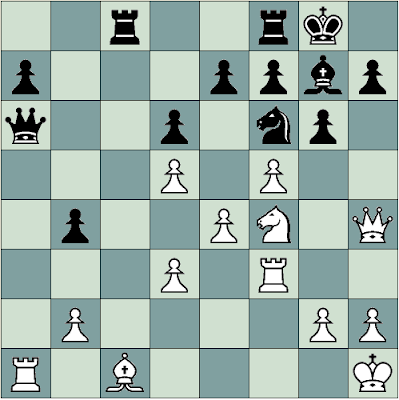
Yesterday I played a rated classical (standard) game on lichess with time control 10 0. This is the position after I played 17. g4. I wanted to open up Black’s kingside (where the king is uncastled) and bring a rook on the eventually-open g-file (or f-file, if lines open up). But my opponent played a move I didn’t think was possible, they played 17. … f4?!, so I responded with 18. exf4, simply winning the pawn. Perhaps Black’s plan could have been to divert my e-pawn to play 18. … d4 (as well as to keep files closed around their king), but no, instead they played 18. … Qxf4??, taking the pawn back:


And they simply resigned after 19. Qxf4+ 1-0.

Then the next day (today), I played a casual (unrated) bullet 2 1 game, and we reached this position:


Here we castled on opposite sides, and I just won a pawn. We’re both planning to attack each other’s king, although my opponent’s attack seems to be coming quite a bit faster--they’ve got both their rooks aligned with my kingside, and the three wing pawns have reached the 4th and 5th ranks. Here I was planning on playing an eventual Bc4, pinning the e6 knight and preventing the move d4, which would prevent my knight from jumping into c4. Eventually I’d also like to develop the queen and bring a rook to the c-file, and play a4, a5, and a6 or b6. But here I decided to hold back on Bc4 in case the bishop is needed for defense on the kingside, so I played 19. Qb3, also preventing d4 and making way for the rooks, with the intention of playing Bc4 next move and pin the knight. My opponent played 19. … g4 and I played 20. Bc4, attacking the knight. Or so I thought--my opponent continued with 20. … g3?, so I took the knight with 21. Bxe6:


And then evidently, my opponent recaptured with 21. … Qxe6?? and resigned after 22. Qxe6 1-0.

So I don’t know what’s going on with my queen…

Both games are available here:


Friday, September 26, 2008

Blunders #1

Here are three games that ended very quickly after big blunders. The first two games show blunders from two very strong and well-known players.

The first game involves GM Nick De Firmian, the author of the most recent Modern Chess Openings (MCO) editions. Here he in fact blunders very shortly after theory has ended. The game started as a Pirc Defense, Austrian Attack, and gave rise to this position after 17. ...Bxf3 (D):
-
De Firmian, N. (2540) - Wolff, P. (2305)
-

White to move


Here De Firmian responded with the natural-looking 18. Rxf3??, only to be confronted with the very brutal 18. ...Qa6!! (D)


He is losing the Rook due to back-rank problems. After 18 moves his c1-bishop is still undeveloped, and it proves decisive here. If he were to play 19. Rb1, Black has 19. ...Qa2 and the Rook is still a goner. The point of 18. ...Qa6 of course is 19. Rxa6 Rxc1+, followed by mate.

The game ended with 19. Be3 Qxa1+ 20. Bg1 Rc1 21. Nh3 Rf1 22. fxg6 hxg6 0-1.


The second game is from a very appreciated player these days, Magnus Carlsen. It's a blitz game played in 2006. This game will maybe be the object of a later endgame analysis here, but for now, let's just look at the very end of the game, where the endgame has simplified greatly:

Carlsen, M. (2675) - Gagunashvili, M. (2591)

White to move


This position is a draw. White played 64. Rxh5, which was rather forced, and Black responded with 64. ...Kxf3 (D):


This position is now more than ever obviously draw, because White has to give up his pawn in order to defend against the mating threat. Or does he? Carlsen played 65. e5??, and got immediately mated with 65. ...Rc1#.


The third game involves amateurs -- but strong players nonetheless. It was played in 2002, and reached an ending too. The endgame was completely won for White, but he messed up... twice. The position after 70. ...d2 (D):

Da Silva, J. (2064) - Singh, R. (2133p)

White to move

Here White threw away the win with 71. Rxc3?? (71. Rxd2+!) 71. ...Kxc3 72. Rxd2. I suspect White missed the following in his calculations: 72. ...Re8+ (D):

0-1 -- White resigned. Up to then I was thinking to myself, what a blunder, he was completely winning and he lost this game. I showed this game to my brother (who has approximately the same rating as I do), to show him the blunder on move 71, and he eventually told me "I don't understand why he resigned". And then it hit me -- the final position is a draw. It seems obvious at first sight that White is lost, but mere calculation would have saved this amateur at least a draw. The most obvious continuation (from the last diagram above) is 73. Kf4 Kxd2 74. Kf5 Rg8 75. Kg6 =.

Do you understand now what I meant when I said White blundered twice in this game? The second blunder was to resign!